
Build a defensible go-to-market plan in five gated decisions.
Positioning, demand engines and a 90-day roadmap, with open questions instead of invented data.
Planning how to take something to market? Start with five decisions, not a blank page.
The Go-To-Market Planner is a free RevOps Studio plugin for Claude Cowork and Claude Code. It walks you through the five decisions of a go-to-market with the logic of Go2Rev.
What do you take away?
Step 01
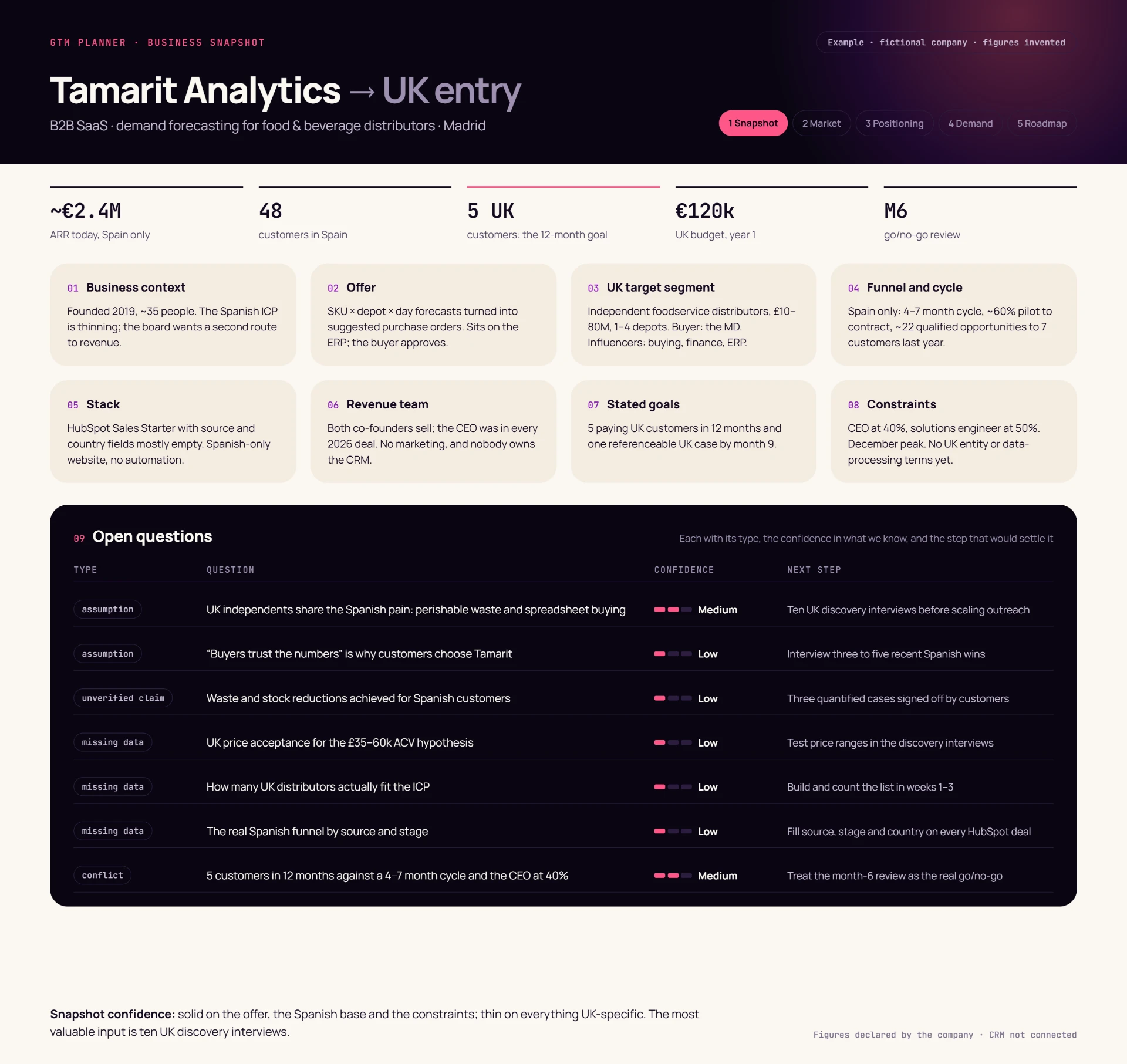
Business Snapshot
An honest picture of where you start.
The planner reads your website, your decks and whatever you tell it, and returns your business on one page. Where a figure is missing, it leaves an open question instead of guessing.
What's on the page
- Key figures, each with its source
- Offer, segment, funnel, stack, team, goals and constraints
- Open questions, with their type, confidence and next step
Example · fictional company Step 02
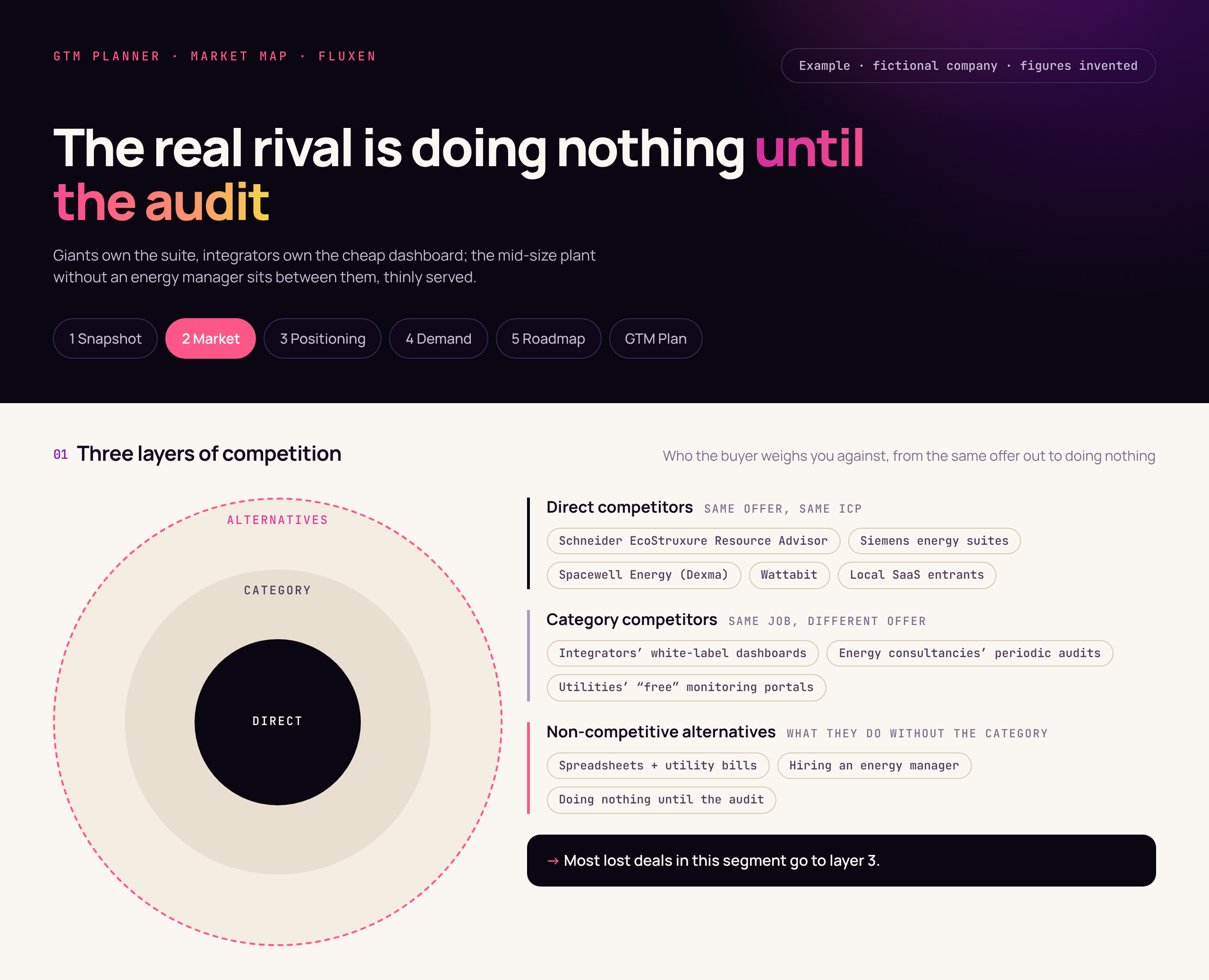
Market Map
Who your buyer really weighs you against.
Competitors are researched on the public web, with their sources. The map separates the gaps worth taking from the empty space nobody wants.
What's on the page
- Three layers: the same offer, the same job done differently, and doing nothing
- A positioning map with its gaps tested
- Priority competitors, each with the weakness that matters to your buyer
- Positioning directions, argued and left for you to decide
Example · fictional company Step 03
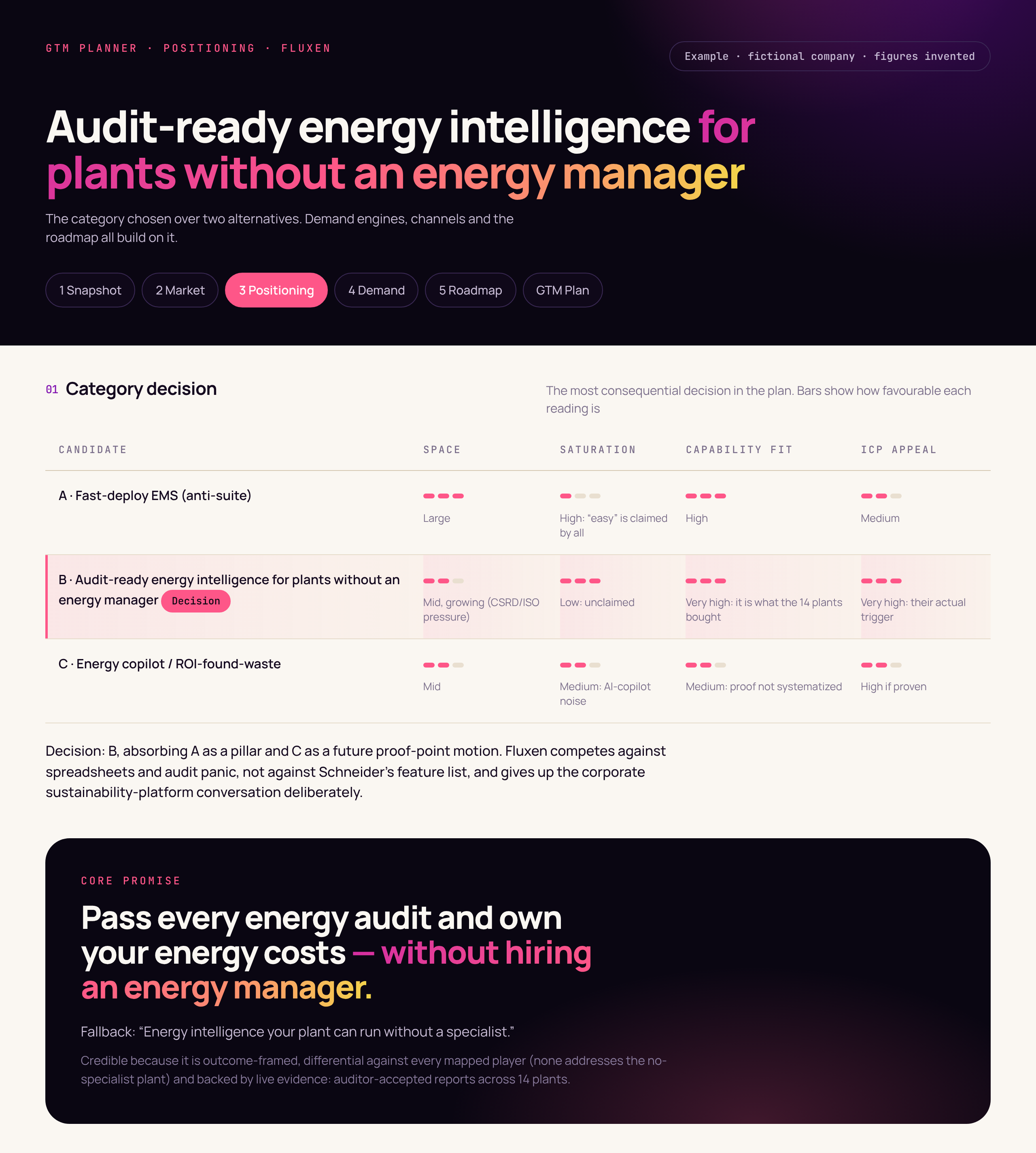
Positioning Architecture
The category you'll compete in, and the promise that goes with it.
The category is chosen against two alternatives, on a matrix you can see. Every pillar must be relevant to your buyer, different from the competitors on the map and defensible with evidence you have today; two out of three is cut.
What's on the page
- Category decision and core promise
- Pillars, each with its test
- A message for each funnel stage
- Anti-messages: what you won't say, and why
Example · fictional company Step 04
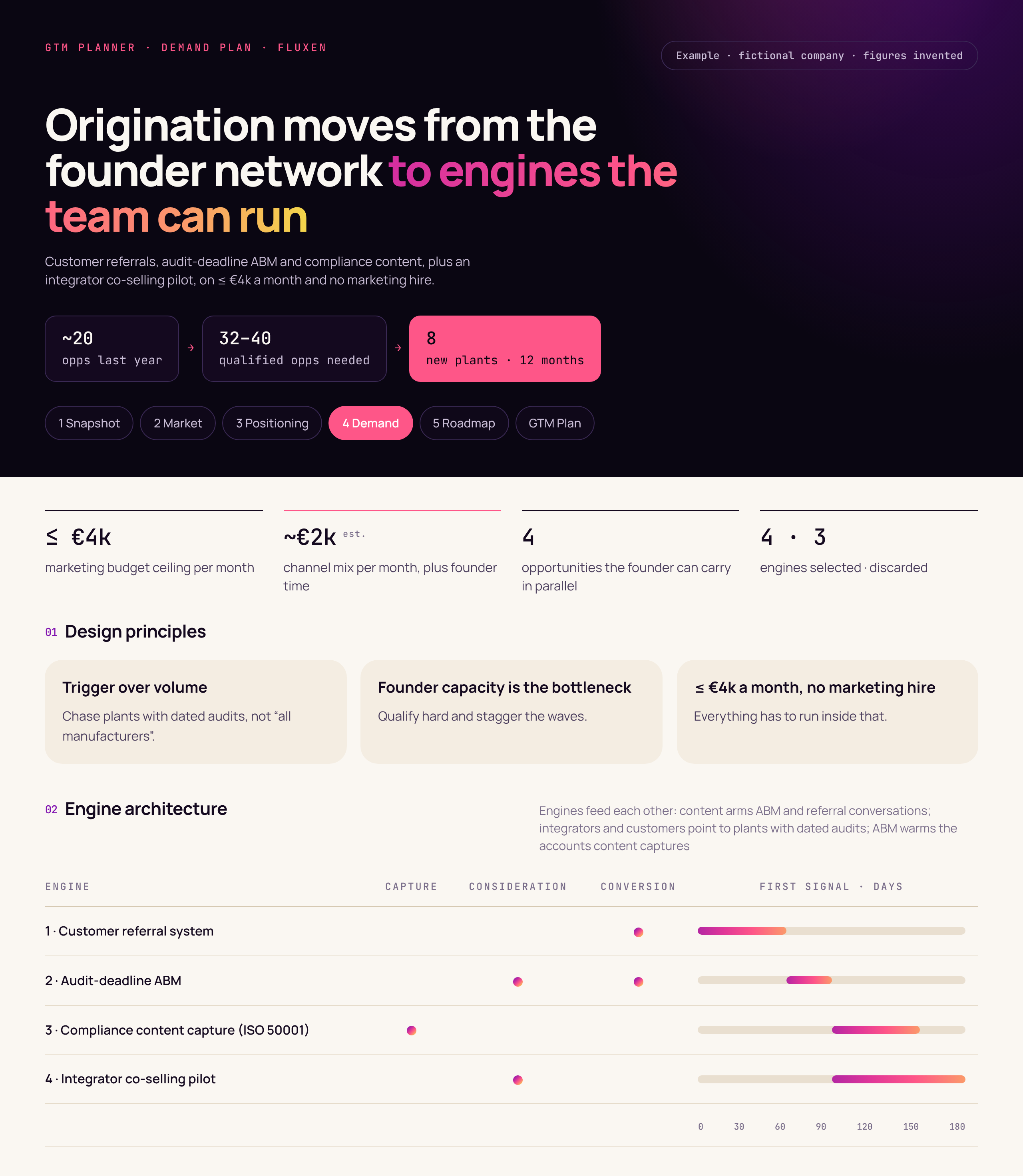
Demand Plan
Repeatable ways to create demand, sized to your team and budget.
Each engine says how it works, what feeds it, how you'll know it's working and how soon. Before researching, the planner shows which sources it can use and what each missing one costs in precision.
What's on the page
- Three to five engines, with time to first signal
- A phased channel mix with its monthly cost
- Benchmarks with their source, or flagged when there is none
- Discarded channels, with the reason
Example · fictional company Step 05
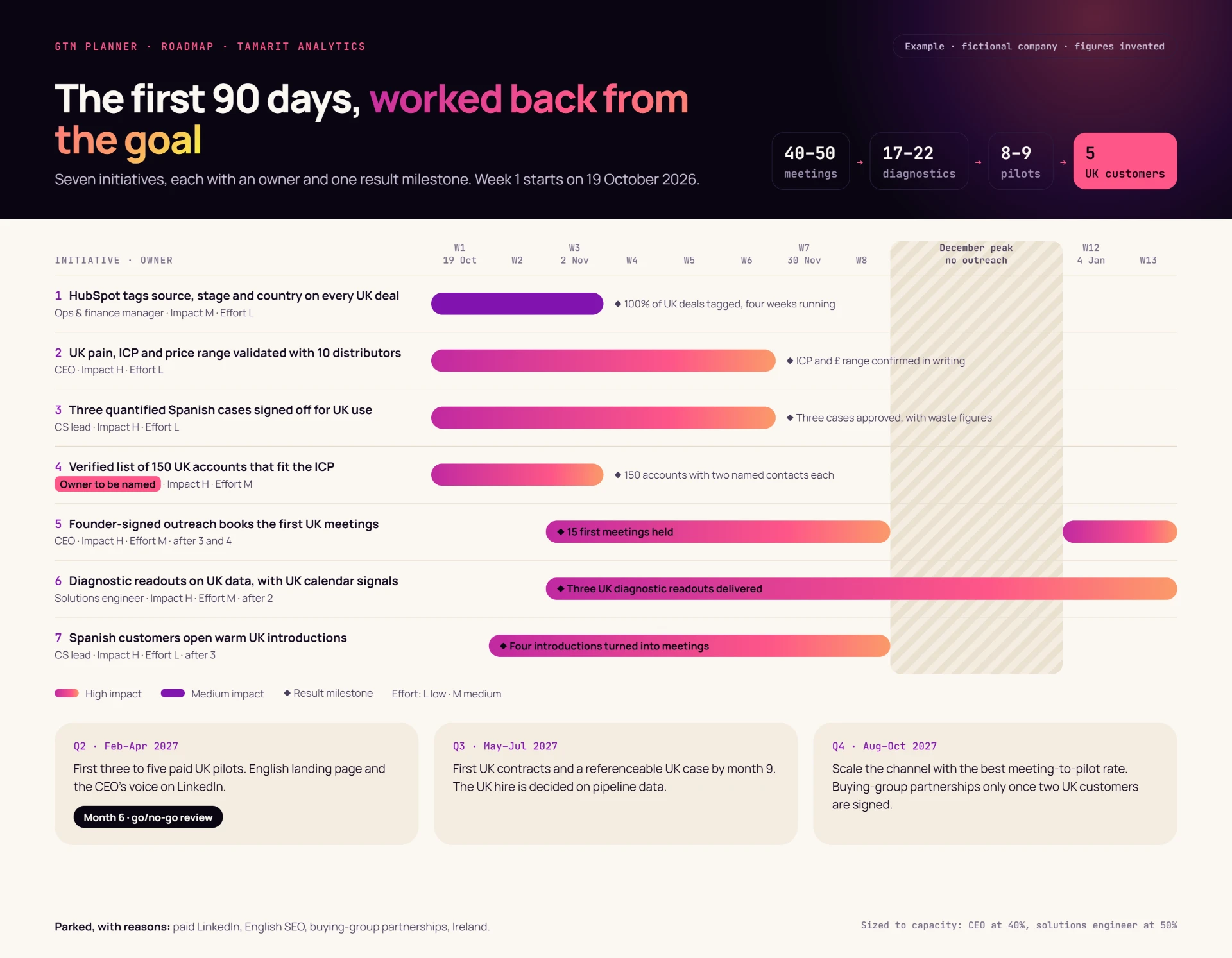
90-day roadmap
The first quarter, worked back from your goal.
Each initiative has an owner, its impact and effort, and one result milestone. Before the plan is consolidated, a final check runs across the five steps to catch what doesn't add up.
What's on the page
- 13 weeks on one chart, with dependencies
- A 12-month outline with its review points
- What was parked, and why
Example · fictional company Result
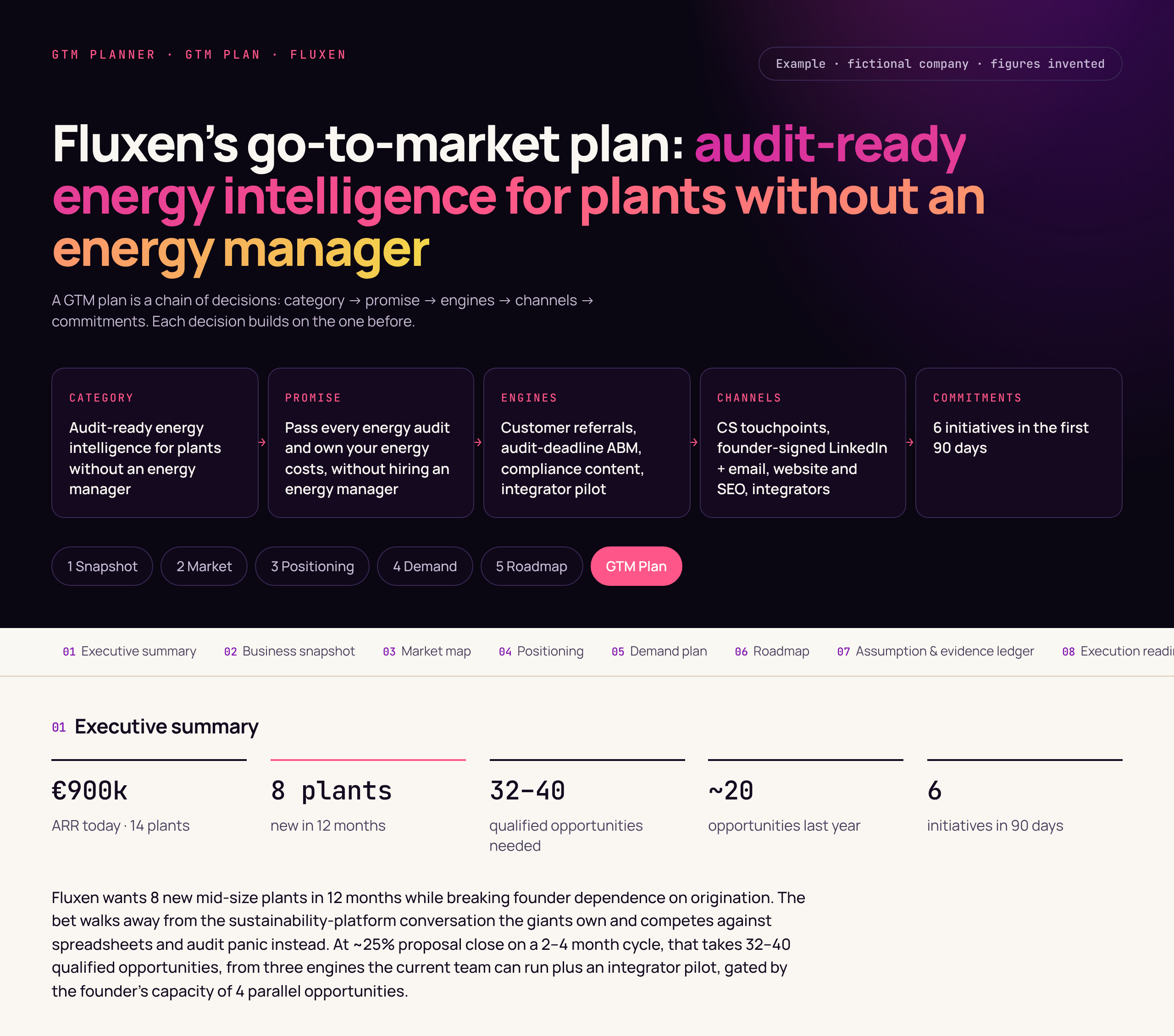
GTM Plan
One document to share, with nothing invented.
The five steps consolidated, from category to commitments, with a ledger of every assumption still open and the risk it carries. It ends with what the plan does not cover and what executing it will take.
What's on the page
- Opens in any browser, works on a phone and prints to PDF
- Each step also leaves its own page
- Open questions travel into the final plan
Example · fictional company


How does it work?
- You confirm or correct at each step
- Your progress is saved between sessions
- An open question instead of an invented figure
- 01
Business Snapshot
- 02
Market Map
- 03
Positioning
- 04
Demand Plan
- 05
Roadmap
It ends honestly, with what the plan does not cover.
What does it not cover?
- Offer and price
- Conversion
- Delivery and collection
- The economics of the initiative
- Activation and handover
That is what Go2Rev does with a consultant.
How do you install it?
Install it from the Anthropic plugin directory. It's free and MIT-licensed.